
Orthotic Devices
Everyday Footwear Choices That Quietly Harm Your Posture
By developer6 min read
Small Shoe Choices, Big Posture Consequences
Footwear seems like a small thing. We grab whatever is near the door, slip it on, and head out to run errands, walk the dog, or enjoy a beach wedding on the sand. But those little choices can quietly shape how your whole body feels at the end of the day.
Your feet are the base of your body. When shoes fight your natural foot motion, your ankles, knees, hips, and spine all have to pick up the slack. Over time, this can show up as stubborn lower back pain, aching hips, tight knees, or constant foot soreness that will not go away.
At our clinic in Fort Walton Beach, we see how everyday footwear adds up. Many posture problems are not from one big injury but from the same small stress repeated step after step. In this article, we will walk through the common shoes that do the most damage, what to look for instead, and how orthotic devices in Fort Walton Beach can help if your feet need extra support.
How Your Feet Shape the Rest of Your Body
Think of your feet like the foundation of a house. If the base tilts or sinks on one side, the walls and roof start to shift. Your arches help absorb shock, your heel is your first point of contact with the ground, and your big toe helps you push off with each step.
Here is what good foot mechanics should do:
- Arches act like springs, taking in impact and sharing it evenly
- Heels land in a neutral position, not rolling far in or out
- Toes spread and push off smoothly, so your stride feels easy
- Knees and hips stack over your feet instead of twisting
When arches collapse or the heel tilts too far inward (overpronation) or outward (supination), the line from your foot up to your hip shifts. Your knees may angle inward, your hips may rotate, and your pelvis can start to tilt forward. That tilt can increase the arch in your lower back and pull your upper body out of balance, often causing tight hamstrings and rounded shoulders as your body tries to compensate.
These changes are usually quiet and slow. One step does not cause pain, but thousands of steps every day in unsupportive shoes can be harder on your body than a single sudden injury. Your posture slowly adapts around your shoes, and not in a good way.
Summer Sandals and Flip-Flops That Sabotage Alignment
On hot, humid summer days in Fort Walton Beach, it is easy to live in flip-flops and flat sandals. They are quick, cool, and perfect for the beach or boardwalk. The problem is that most of them are not made with your posture in mind.
Common issues with basic flip-flops and beach sandals include:
- Almost no arch support, so your foot collapses inward
- Thin soles that let every step pound into your joints
- Loose fit that makes you curl your toes to keep them on
- Extra tension in the calves and shins from that “toe grip”
That constant toe gripping can change how you walk. Your strides get shorter, your ankles lose some stability, and your knees and hips must work harder to control motion. Over time, your lower back may start to feel the extra strain.
Fashion sandals can cause problems too, especially if they are very flat, have no structure under the arch, or sit on high, unstable platforms. When your foot slides around or tips easily, your ankles and knees twist to catch your balance, and that twist can travel up to your hips and spine.
Healthier summer footwear does not have to be bulky or boring.
A contoured footbed that matches the curve of your arch
Secure straps around the ankle or midfoot so you do not have to claw with your toes
A slight heel-to-toe drop instead of an entirely flat sole
A sole that bends at the ball of the foot but feels stable under the arch and heel
These small changes help your feet move more naturally so the rest of your body stays in better alignment.
Hidden Posture Riskvbs in Work and Workout Shoes
Many work shoes and dress shoes quietly pull your body out of balance. Ballet flats and very flat loafers often look neat and simple but usually have no arch support or cushion. Your feet may roll inward and your knees follow, which can bother your hips and lower back.
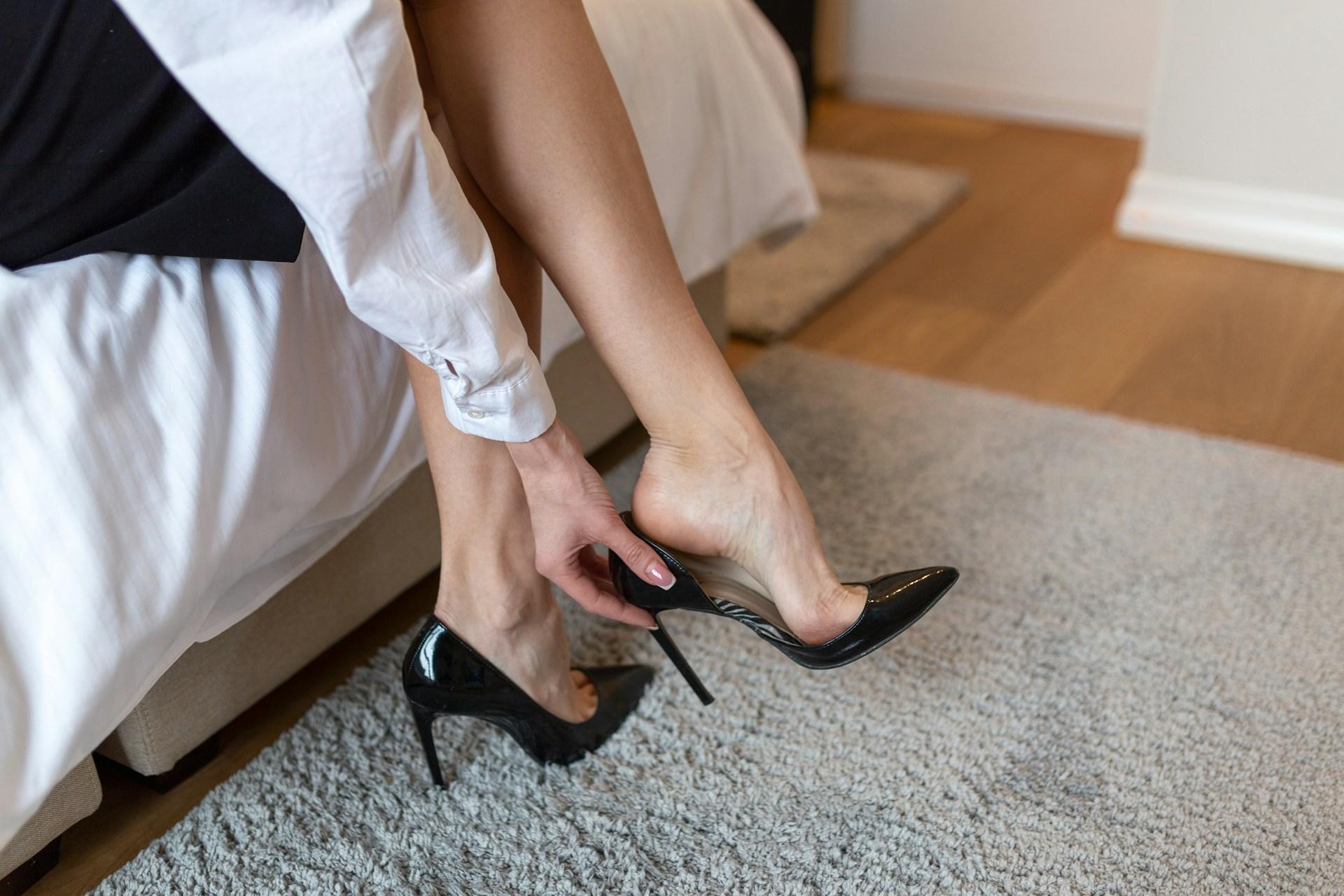
High heels and narrow toe boxes bring their own set of issues:
- Weight shifts toward the front of the foot
- Toes get squeezed together and lose their natural spread
- Calf muscles stay shortened and tight
- The pelvis tips forward, deepening the curve in the lower back
If you stand or walk in this position for hours, day after day, your body starts to think that is your new “normal.”
Workout shoes can also create problems when they are not right for your feet. Overly cushioned shoes can sometimes let your foot roll too much. Worn-out shoes lose support in the midsole, so your arches drop with every step. Shoes that do not match your foot shape or activity can change how your joints line up when you walk, run, or lift weights.
Helpful habits for work and workout shoes:
- Replace athletic shoes when the tread is worn or the midsole feels flat
- Check that you have a thumb’s width of space in front of your toes
- Make sure your heel is snug without sliding
- Notice if your arch feels supported but not pinched
All these small checks help cut down the micro-strain that builds up into bigger posture issues.
When to Consider Orthotic Support for Better Posture
Sometimes changing shoes alone is not enough, especially if your feet already have significant alignment issues. Orthotic support can help guide your foot into a better position with each step.
There is a difference between simple store-bought insoles and custom, medically guided orthotic devices in Fort Walton Beach. Generic insoles give basic cushion. Custom devices are shaped to your unique arch, heel position, and movement patterns.
You may want a professional opinion if you notice:
- Persistent heel or arch pain, especially first thing in the morning
- Recurring knee or hip discomfort that keeps coming back
- One-sided lower back pain or feeling “crooked”
- Shoes that wear out unevenly on one side of the heel or sole
A multidisciplinary clinic can look at your feet, gait, and spine together. This kind of full-body view helps reveal how your foot posture connects to the rest of you. Orthotics can then be part of a plan that may also include chiropractic care and physical therapy to address stiffness, weakness, and movement habits.
Orthotics can be especially helpful in the busy summer months, when you are walking on sand, hard walkways, and standing through long outdoor events. Better support early on can help prevent flare-ups of old pain as your activity level goes up.
Build a Footwear and Posture Plan You Can Live With
One simple first step is a “shoe audit” at home. Lay out the pairs you wear the most in a normal week. Look for shoes that are very flat, bend in half easily, feel flimsy, or already cause soreness. Those go on your “limit or replace” list.
Then think about building a small rotation of shoes that actually support you. A realistic plan might include:
- One or two supportive pairs for daily errands and work
- Healthier sandals for beach days and casual outings
- Proper athletic shoes for workouts or long walks
- Orthotic devices, if recommended, that can move between pairs
Pairing better footwear with simple daily mobility and strength work is also helpful. Gentle ankle circles, calf stretches, and basic hip and glute exercises can support what your shoes and orthotics are trying to do for your posture.
At White Sands Integrative, we focus on how all these pieces fit together, from your feet to your spine. Small footwear changes, made with a clear plan, can help protect your posture, reduce pain, and keep you moving comfortably on the beach and beyond all year long.
Take The Next Step Toward Pain-Free Movement
If foot, knee, or back pain is holding you back, our team at White Sands Integrative is ready to help you find lasting relief. We will evaluate your movement patterns, lifestyle, and health history to determine whether customized orthotic devices in Fort Walton Beach are right for you. Schedule your visit today so we can build a care plan that supports your comfort, mobility, and long-term joint health.
Recent Blogs
Fort Walton Beach Well-being: Enhance Health with Physical Therapy
Welcome to White Sands Integrative Medical, where we are committed to helping our Fort Walton Beach community achieve optimal health and well-being. Today, we want…
Learn more: Fort Walton Beach Well-being: Enhance Health with Physical TherapyWave Goodbye to Pain: The Healing Power of Shockwave Therapy
In the heart of Fort Walton Beach, FL, White Sands Integrative Medical is at the forefront of providing innovative treatments to help you manage pain…
Learn more: Wave Goodbye to Pain: The Healing Power of Shockwave TherapyRevitalize Your Health: The Power of PRP Injections at White Sands Integrative Medical
Welcome to White Sands Integrative Medical, your trusted chiropractic clinic in Fort Walton Beach, FL. As the leading provider of integrative medical solutions in the…
Learn more: Revitalize Your Health: The Power of PRP Injections at White Sands Integrative Medical
Ready to Feel Better?
Schedule your visit at White Sands Integrative Medical in Fort Walton Beach, FL or call our team with any questions.